History-Dependent Monetary Policy and Wage Rigidity at the Zero Lower Bound
Under reviewWage rigidity cushions a zero-lower-bound recession under inflation targeting but deepens it once policy is sufficiently history-dependent.
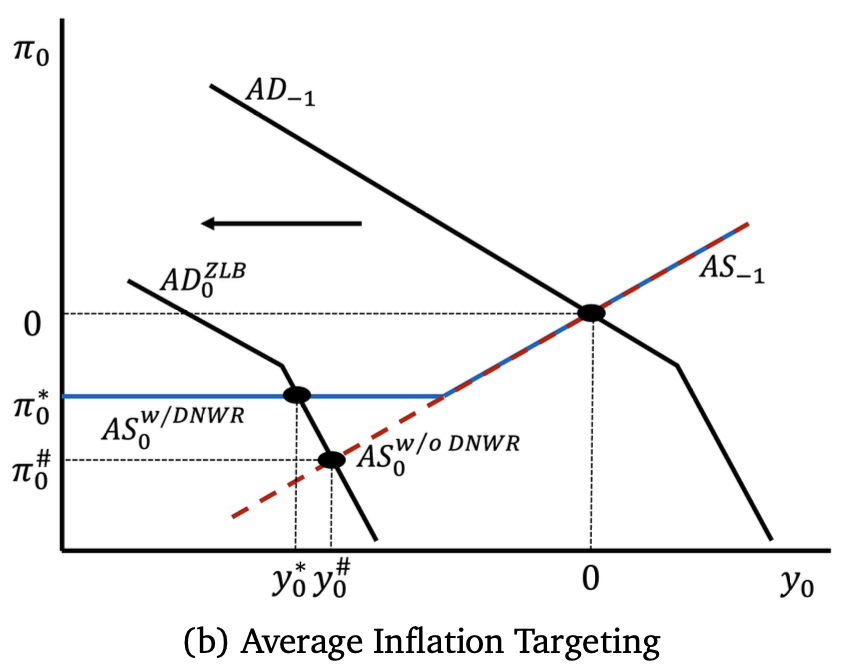
This paper shows that the macroeconomic effects of downward nominal wage rigidity (DNWR) at the zero lower bound (ZLB) depend critically on monetary-policy history dependence. In a New Keynesian model with occasionally binding ZLB and DNWR constraints, wage rigidity operates through two opposing forces. By limiting the decline in marginal cost and inflation while the ZLB binds, DNWR lowers the real interest rate and stabilises demand. Under history-dependent policy, however, the smaller inflation or price-level shortfall also reduces the future accommodation that agents expect, weakening the expectations channel that supports demand at the ZLB. We show analytically that this second force reverses the output effect of DNWR once policy is sufficiently history-dependent. In the quantitative model, the reversal occurs at interior degrees of history dependence and is robust to alternative calibrations. Under current inflation targeting DNWR mitigates the recession, whereas under sufficiently history-dependent average inflation targeting and price-level targeting it amplifies the contraction. The same mechanism operates under Ramsey-optimal policy, where DNWR weakens the low-for-long accommodation that supports expected inflation and current demand.